
Labial and Buccal Frenectomy
Free your smile with our quick, painless frenectomy procedure.
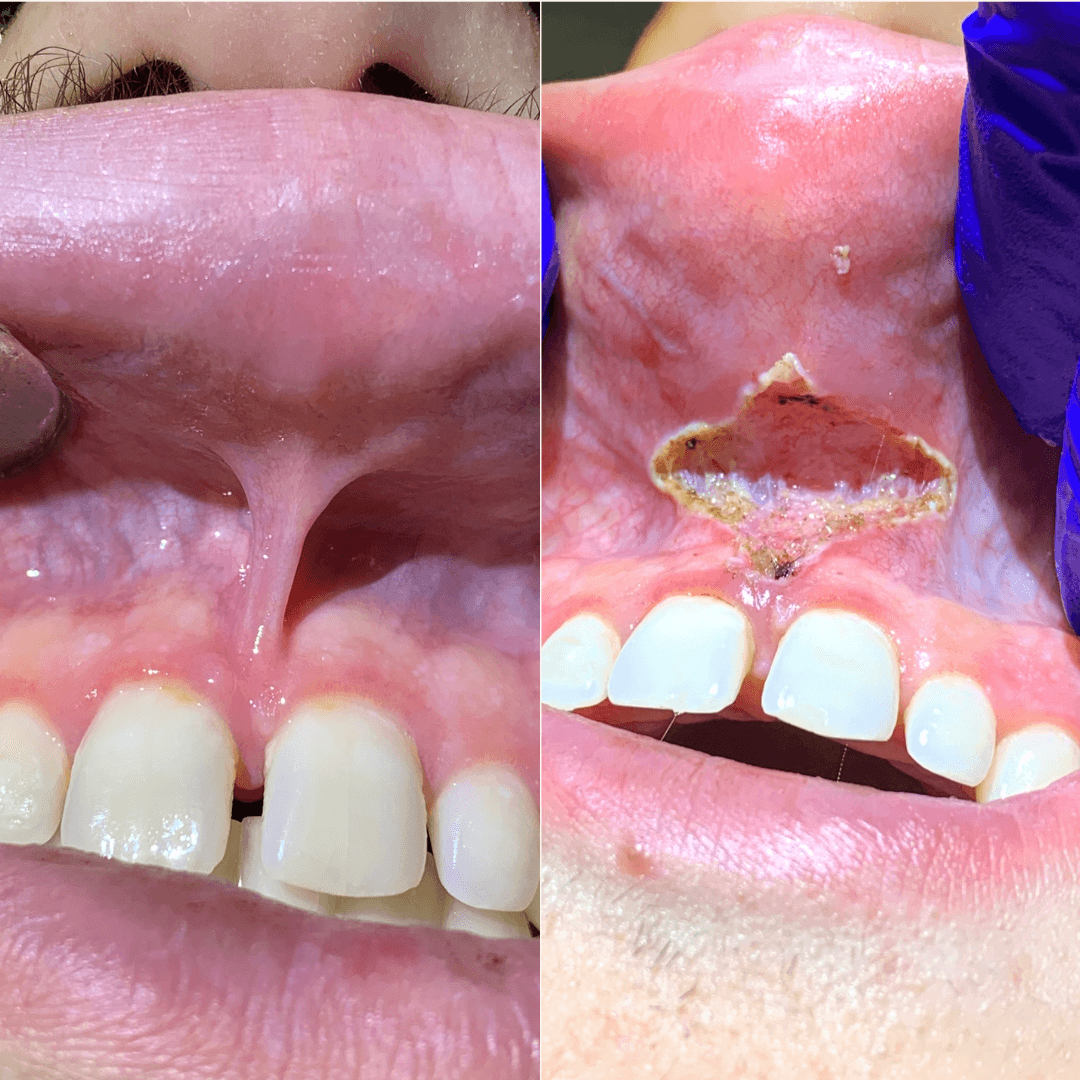
LABIAL FRENECTOMY PAGE
Labial and Buccal Frenectomy – Preventing Gum Recession and Closing Gaps
At Bedrock Dentistry, our labial and buccal frenectomy procedures remove or release tight tissue bands that connect your lips to your gums, preventing gum recession, closing gaps between teeth, and improving oral function. A frenum is a small fold of tissue, and when the labial or buccal frenum is too tight, thick, or positioned incorrectly, it can pull on your gums every time you smile or talk, causing progressive gum recession, gaps between teeth, and discomfort that a simple frenectomy can resolve.
What is a labial or buccal frenectomy and why would I need one?
A labial or buccal frenectomy releases the tissue band that connects your lips or cheeks to your gums. The labial frenum runs from your upper or lower lip to the gum tissue between your front teeth, while buccal frenums connect your cheeks to your gums on the sides of your mouth. When these tissue bands are too thick or attached too close to your teeth, they create constant pulling tension that damages your gums and dental health.
You may need a labial or buccal frenectomy if you experience:
Gum recession: A tight frenum pulls on your gum tissue every time you smile, talk, or move your lips, creating constant tension that causes the gums to pull away from your teeth over time. This exposes tooth roots, increases sensitivity, and raises the risk of root decay and bone loss. Left untreated, gum recession from a tight frenum can progress until teeth become loose or require extraction
Gap between front teeth (diastema): When the upper labial frenum is too thick or extends too far down between the front teeth, it prevents the teeth from naturally coming together and maintains a persistent gap that won't close even with braces. Removing the frenum allows orthodontic treatment to successfully close the space
Difficulty with dentures or oral appliances: A prominent frenum can interfere with denture fit, cause discomfort when wearing removable prosthetics, or prevent proper sealing of dental appliances
Discomfort when brushing: Tight frenums make it painful or difficult to properly clean your teeth and gum line, leading to plaque buildup and increased gum disease risk
Pain when smiling or eating: An overly tight labial or buccal frenum can cause pulling sensations or pain during normal facial movements
Removing or releasing the frenum eliminates the pulling force on your gums, prevents further recession, allows orthodontic gap closure, and improves comfort and function.
How does labial frenectomy prevent gum recession?
Gum recession caused by a tight labial frenum is progressive and irreversible without intervention. Every time you smile, laugh, talk, or move your lips, the frenum pulls on the attached gum tissue, gradually forcing it away from the tooth surface. Over months and years, this creates visible recession, exposed tooth roots, sensitivity, and increased risk of root cavities and bone loss.
A labial frenectomy removes this constant pulling force, stopping the recession from progressing further. In many cases, we perform the frenectomy at the same time as gum grafting to both eliminate the cause (the tight frenum) and repair the damage (restore receded gum tissue), giving you the best long-term outcome and preventing the recession from returning.
What happens during a labial or buccal frenectomy procedure?
At Bedrock Dentistry, we use the advanced Fotona Lightwalker laser for most labial and buccal frenectomy procedures, offering patients a more comfortable, precise, and efficient treatment experience. The Fotona Lightwalker is a state-of-the-art dental laser that removes the restrictive tissue band with minimal bleeding, reduced post-operative discomfort, and faster healing compared to traditional surgical methods.
During a laser labial or buccal frenectomy, we numb the area with local anesthesia so you feel no pain. The laser precisely removes or releases the frenum attachment while simultaneously sealing blood vessels and sterilizing the area, which means less bleeding during the procedure, minimal swelling afterward, and often no need for stitches. The procedure typically takes only 10-20 minutes, and most patients experience significantly less discomfort than traditional surgical techniques.
In some cases, we use traditional surgical technique when the frenum is particularly thick or fibrous, when we're combining the frenectomy with gum grafting procedures, or when the tissue anatomy requires more extensive reshaping. With traditional surgical labial or buccal frenectomy, we use precise instruments to remove the tissue band and may place a few small dissolving stitches.
Recovery is usually straightforward, with mild soreness for a few days that's easily managed with over-the-counter pain medication. We'll provide specific care instructions and may recommend gentle stretching exercises to prevent scar tissue formation and ensure optimal healing.
Can labial frenectomy close the gap between my front teeth?
Yes, but timing and orthodontics matter. If you have a gap between your front teeth (diastema) caused by a thick or low-attached labial frenum, removing the frenum is essential for successful gap closure. However, the frenectomy alone doesn't close the gap—it removes the tissue barrier that's preventing closure.
For children and teenagers still undergoing growth and development, we often perform the frenectomy first, then allow orthodontic treatment (braces or clear aligners) to close the space naturally. For adults, we may coordinate with your orthodontist to perform the frenectomy at the optimal point during orthodontic treatment. Without removing the frenum first, orthodontic gap closure often fails or the gap reopens after braces are removed because the frenum tissue pushes the teeth apart again.
Who benefits most from labial or buccal frenectomy?
Children and teenagers benefit from labial frenectomy before or during orthodontic treatment to allow successful gap closure, prevent gum recession from developing, and establish healthy oral tissue patterns.
Adults who notice progressive gum recession, gaps between teeth that won't close, or discomfort when smiling should have the frenum evaluated before more serious gum damage occurs. Labial frenectomy is often performed together with gum grafting procedures to both stop the cause and repair existing recession for comprehensive, lasting results.
Why choose Bedrock Dentistry for labial frenectomy in Austin?
Our periodontal specialists perform labial and buccal frenectomy procedures using the advanced Fotona Lightwalker laser system for maximum comfort and precision, with traditional surgical options available when clinically indicated. We'll evaluate your specific frenum attachment, explain exactly how the procedure will prevent further gum recession or allow gap closure, recommend the best technique for your case, and coordinate with your orthodontist if needed. If you've noticed receding gums, a persistent gap between your front teeth, or discomfort when brushing or smiling, contact us for a thorough evaluation—a simple labial frenectomy can prevent serious gum problems and protect your smile for decades to come.
Comprehensive Dental care in Austin
Amazing care for amazing smiles
Ready to experience top-tier dental care?
Dr. Ashwin Nambisan, Dr. Rajani Bhore and our warm Bedrock Dentistry team are here to welcome you and make you smile more confidently!