
Esthetic Dental Implants
Replace missing teeth seamlessly with our premium single implants
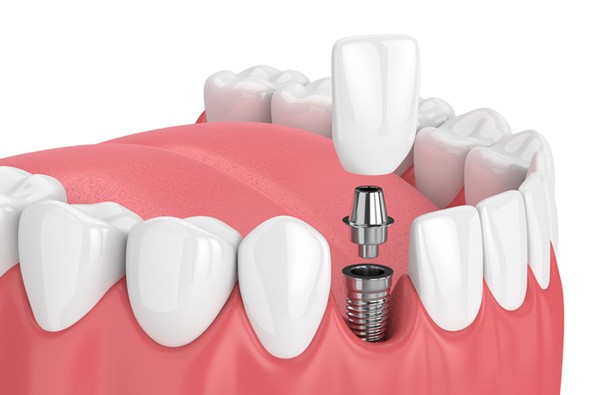
Esthetic Dental Implants in the Smile Zone – Natural-Looking Front Tooth Replacement
At Bedrock Dentistry, our esthetic dental implants replace missing or damaged front teeth with beautiful, natural-looking results that blend seamlessly with your smile. Unlike back teeth that focus purely on chewing function, front tooth implants in the "smile zone"—your visible upper and lower front teeth—require advanced surgical planning, precise positioning, and artistic attention to gum contours, tooth shape, and color so your new tooth looks like it naturally belongs in your smile.
What makes front tooth dental implants different from back tooth implants?
Front tooth implants demand a higher level of precision and esthetic planning because even small positioning errors become visible when you smile, talk, or laugh. The implant must be placed at exactly the right depth, angle, and distance from neighboring teeth to support a crown that emerges naturally from the gums without creating dark shadows, uneven gum lines, or artificial-looking contours.
Because front teeth are highly visible and have thinner bone and delicate gum tissue compared to back teeth, esthetic implant placement requires careful evaluation of your bone structure, gum thickness, smile line, and facial proportions before surgery. This is why we use advanced 3D imaging and digital planning to design your implant position before we ever make an incision.
Why is CBCT (3D imaging) essential for planning esthetic implants?
CBCT (Cone Beam Computed Tomography) is a specialized 3D X-ray scan that shows us the exact thickness, density, and contours of your jawbone in all three dimensions. Before placing a front tooth implant, we use CBCT to measure precisely how much bone is available, identify the exact position of nerve channels and blood vessels, and digitally plan the ideal implant angle and depth that will support a natural-looking crown and healthy gum architecture.
Without CBCT planning, we would be guessing at bone quality and implant positioning, which significantly increases the risk of placing the implant too far forward (creating a bulky, unnatural appearance), too far back (making the crown look sunken), or at the wrong angle (causing gum recession or dark shadows at the gum line). CBCT allows us to plan every millimeter of your implant placement before surgery, ensuring predictable, beautiful results that last for decades.
Do I need bone grafting or gum grafting for a front tooth implant?
Most esthetic dental implants require bone grafting to create adequate bone volume and proper ridge contours that support both the implant and the overlying gum tissue. When a front tooth is lost due to trauma, infection, or gum disease, the surrounding bone shrinks and collapses inward, leaving insufficient structure to hold an implant or create natural gum contours.
During your implant placement, we typically add bone graft material around the implant to fill gaps, rebuild the ridge width, and create the proper foundation for healthy, even gum tissue. This bone graft material stimulates your body to grow new natural bone over the following months, ensuring long-term implant stability and esthetic success.
Soft tissue grafting (gum grafting) is also frequently performed at the same time as implant placement to increase gum thickness, create ideal gum height around the implant, and establish the pink esthetic framework your crown needs to look natural. Thick, healthy gum tissue prevents recession around the implant crown, hides the metal implant components beneath, and creates natural scalloped contours that match your adjacent teeth. We may use tissue from your palate or acellular dermal matrix (ADM) depending on how much tissue augmentation you need.
What is an angled abutment and when is it used?
An angled abutment is a custom connector piece that attaches to the implant and corrects the angle at which the crown emerges from the gums. Sometimes, ideal implant positioning for bone support requires placing the implant at an angle that doesn't perfectly align with how your natural tooth should emerge. Rather than compromise the implant position or accept an unnatural-looking crown, we use an angled abutment to adjust the angle between the implant and the crown, ensuring your final tooth looks perfectly natural and symmetrical with your other front teeth.
Angled abutments are especially useful when working with limited bone, avoiding adjacent tooth roots, or correcting the emergence profile to match your natural smile design. This allows us to optimize both the surgical placement (for long-term stability) and the esthetic outcome (for a beautiful, natural appearance).
How do we design your smile to look natural?
Your esthetic implant crown is custom-designed to match the shape, color, translucency, and surface texture of your natural teeth. We take detailed photos of your smile, evaluate your tooth proportions, and work with specialized dental laboratories to create a crown that blends invisibly with your existing teeth. The gum contours are shaped to match the scalloped, natural curve of your adjacent teeth, and we carefully design the way light reflects off the crown surface to mimic natural enamel.
Your smile design takes into account your facial features, lip position, gum display when smiling, and even subtle asymmetries in your natural teeth to ensure the implant crown looks like it's always been part of your smile—not like an obvious replacement.
What do I wear while my implant heals?
During the healing period after implant placement, we provide a temporary prosthetic so you're never without a visible tooth in your smile zone. Options include:
Flipper: A removable retainer-like appliance with a temporary tooth attached that you can take in and out
Essix tray with fake tooth: A clear removable retainer with a tooth-colored replacement bonded inside
Temporary implant crown: In select cases where bone stability allows, we may place a temporary crown directly on the implant
Critical rule: Your temporary tooth or implant crown must NOT be used for biting or chewing during the healing period. Any pressure on a healing implant can cause micro-movement that prevents proper bone integration (osseointegration), leading to implant failure. The implant needs 3-4 months of undisturbed healing to fuse completely with your jawbone before it can handle chewing forces.
Even though you'll have a tooth visible when you smile, you must avoid biting into food with that temporary replacement and keep all chewing forces on your other teeth until we confirm the implant has fully integrated. Once healing is complete, we'll place your final custom esthetic crown, and you can resume normal eating and function with complete confidence.
Why choose Bedrock Dentistry for esthetic dental implants in Austin?
Our periodontal specialists combine advanced CBCT planning, microsurgical implant placement techniques, and artistic smile design to deliver front tooth implants that look and feel completely natural.
We understand that losing a front tooth affects not just your ability to eat, but your confidence, self-image, and willingness to smile freely.
If you've lost a front tooth or been told you need extraction, contact us for a comprehensive esthetic evaluation—we'll show you exactly how we can restore your smile with precision, artistry, and results that last a lifetime.
Comprehensive Dental care in Austin
Amazing care for amazing smiles
Ready to experience top-tier dental care?
Dr. Ashwin Nambisan, Dr. Rajani Bhore and our warm Bedrock Dentistry team are here to welcome you and make you smile more confidently!